Learn
Editorial review
Run sixteen rule-based checks and six model reads across a chapter or a manuscript, then accept or decline what it finds.
You can run an editorial review at whatever scope fits, read its report, and act on each suggestion one at a time.
Chapter, manuscript, or part
Start an editorial review from a chapter, from a whole manuscript, or from a single world part, and the analysis runs at that scope only. A single chapter’s review reads fast; a whole manuscript’s review is the same checks run across every chapter in it, gathered into one report.
The sixteen rule and count checks
Most of what a review finds comes from sixteen checks that count and measure rather than guess: overused words, sentence length against a guidance band, the share of “sticky” sentences glued together with filler words, passive voice, readability scores like Flesch-Kincaid and SMOG, dialogue tags, and more. Each one reports a number and, where it makes sense, the threshold it was measured against.
The six model reads
Alongside the counting checks, six others read the chapter the way a person would, using the model running on your machine rather than a fixed rule, the kind of judgment call a spreadsheet cannot make on its own, like whether the point of view actually drifts partway through a scene.
Reading a report
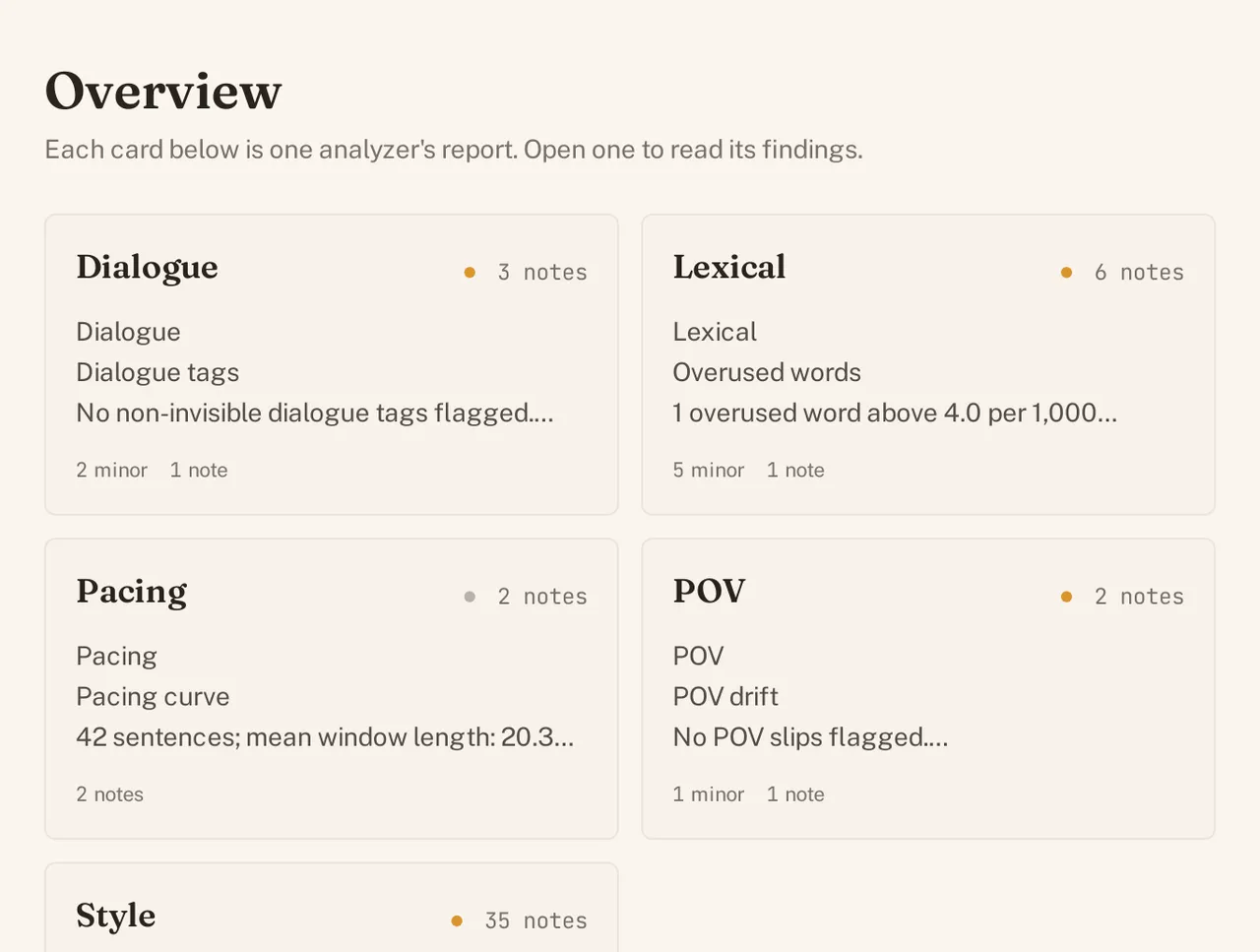
The overview is one card per analyzer, Dialogue, Lexical, Pacing, POV, Style, and the rest, each showing how many notes it has and a one-line summary. Open a card and it expands into the full detail behind that summary: the actual numbers, the guidance band they were measured against, and which sentences triggered a flag.
Accept change and Decline
Where a check suggests an actual rewrite rather than just pointing something out, you get two buttons on it: Accept applies the change to your chapter, Decline leaves your words untouched and moves to the next suggestion. Nothing is applied to your manuscript until you say so.
See Reviews for what happens to a review after you close it, and Grammar and spelling for the lighter pass that runs as you type instead of on demand.